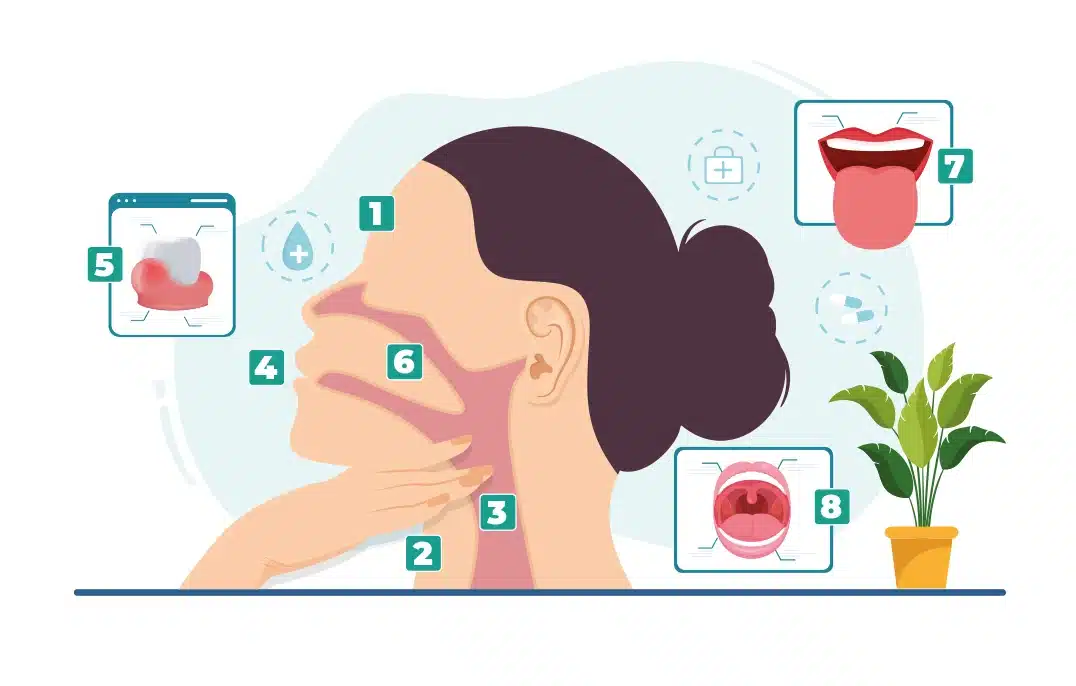
How to check for head and neck cancer at home
Regular self-checks play a vital role in the early detection of Head and Neck cancer.
By familiarising yourself with your body and paying attention to any changes, such as lumps, sores, or persistent symptoms like a sore throat or difficulty swallowing, you can identify potential signs of cancer at an early stage.
Early detection significantly improves treatment outcomes and can save lives.
Make self-checks a routine part of your healthcare regimen to stay proactive about your health and well-being.
Regular check ups with a dentist is also helpful as they should perform a cancer symptom check as part of your oral health review.
1Face
FACE Look at the whole face – are there any swellings you haven’t noticed before? Inspect your skin – has anything changed recently? Have moles become larger or started to itch or bleed? Turn your head from side to side – this stretches the skin over the muscles making lumps easier to see.
2Neck
NECK Run your fingers under your jaw and feel along the large muscle either side of neck using the balls of your fingers. Are there any unusual swellings? Does everything feel the same on both sides?
3Lips
LIPS Use your fingers and thumb to feel the inside of your mouth. Pull your upper lip upwards and bottom lip downwards. Look inside for any sores or changes in colour
4Gums
GUMS Use your thumb and forefinger. Examine your gums feeling around the gum for anything unusual.
5Cheeks
CHEEKS Use your fingers and thumb to feel the inside of your mouth. Pull your upper lip upwards and bottom lip downwards. Look inside for any sores or changes in colour. Open your mouth and pull your cheeks away, one side at a time, with your finger. Look for any red or white patches. Does everything feel the same on both sides? Use your finger in the cheek to check for ulcers, lumps or tenderness. Repeat on the other side. Your tongue can be helpful to locate sore areas, ulcers or rough patches
6Tongue
TONGUE Gently stick out your tongue and look at one side first and then the other. Look for any swelling, ulcers or change in colour. Examine the underside of your tongue by lifting the tip of your tongue to the roof of your mouth.
7Mouth
FLOOR AND ROOF OF MOUTH Tilt back your head and open your mouth wide to inspect the roof of your mouth. Look to see if there are changes in colour or ulcers. Check for changes in texture with your finger. Lift your tongue up and look underneath at the floor of your mouth. Look for any colour changes that are unusual. Gently press your finger along the floor of your mouth and under your tongue. Feel for any lumps, swellings or ulcers.